

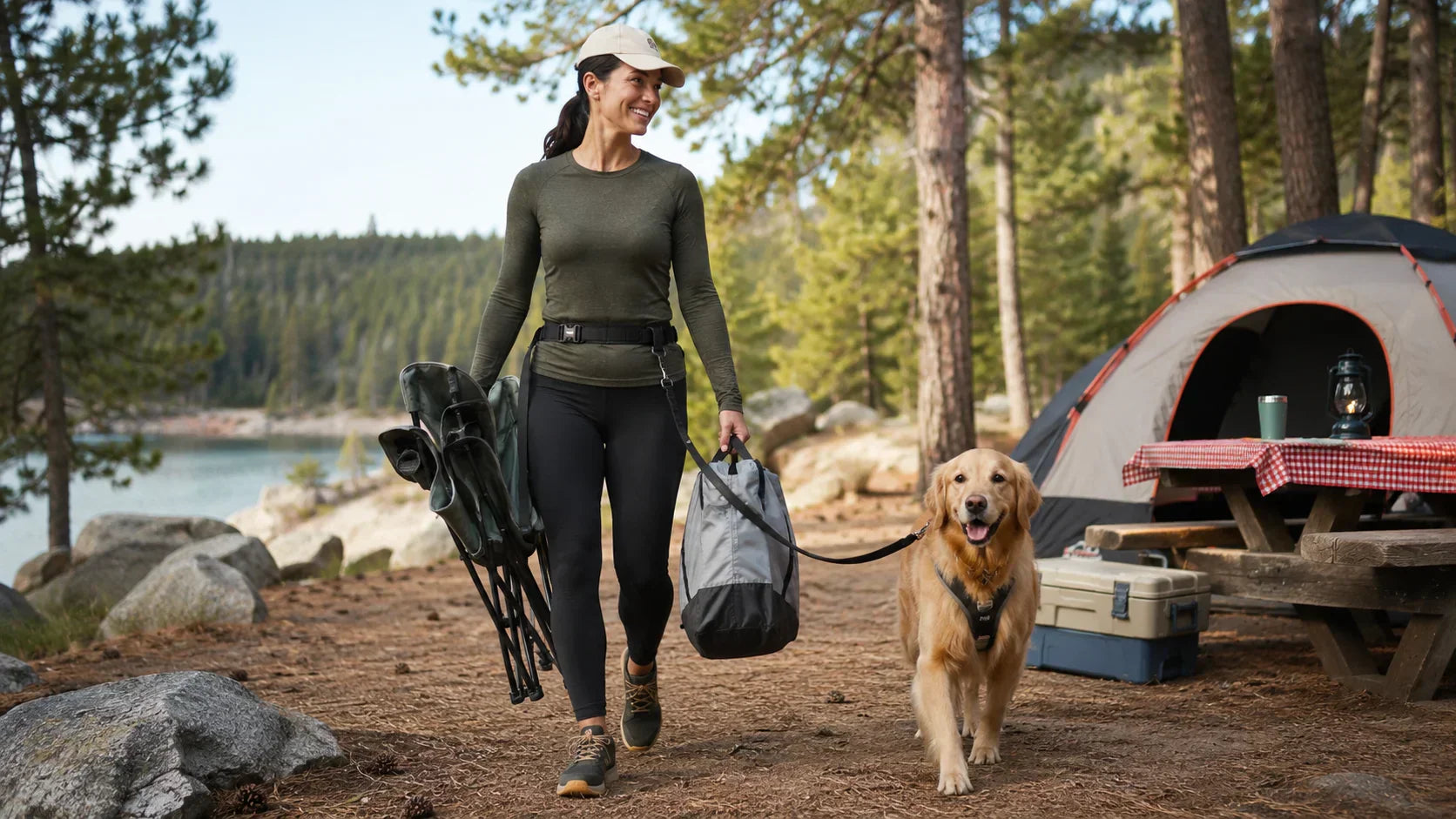
- by JonesMila
6 Best Hands-Free Dog Leashes for Walking, Running, and Jogging
- by JonesMila
Walking or running with your dog should feel natural, comfortable, and enjoyable. However, holding a traditional leash can make it difficult to swing your arms, carry water, check your phone, or maintain a steady running rhythm. This is where a hands free dog leash can make a noticeable difference.
In this guide, we explain how hands-free leashes work, their advantages and limitations, the features that matter most, and six popular options for walking, running, and jogging with your dog.
A hands free dog leash is a leash designed to connect to a belt around your waist or, in some cases, wrap across your body. Because the leash remains attached without requiring constant hand control, you can move your arms naturally while walking, jogging, hiking, or running.
Most waist-worn systems include two main parts: an adjustable waist belt and a leash that connects the belt to the dog. Some designs use a separate belt and leash, while others use a single adjustable strap that converts between waist-worn, crossbody, and handheld modes.
A hands-free leash does not mean that you lose all direct control. Many products include a traffic handle or grab handle near the dog, allowing you to shorten the distance when approaching roads, other dogs, cyclists, or crowded areas.
Elastic or bungee sections are also common. These sections stretch slightly when the dog changes pace, helping reduce abrupt pulling on both the owner and the dog.
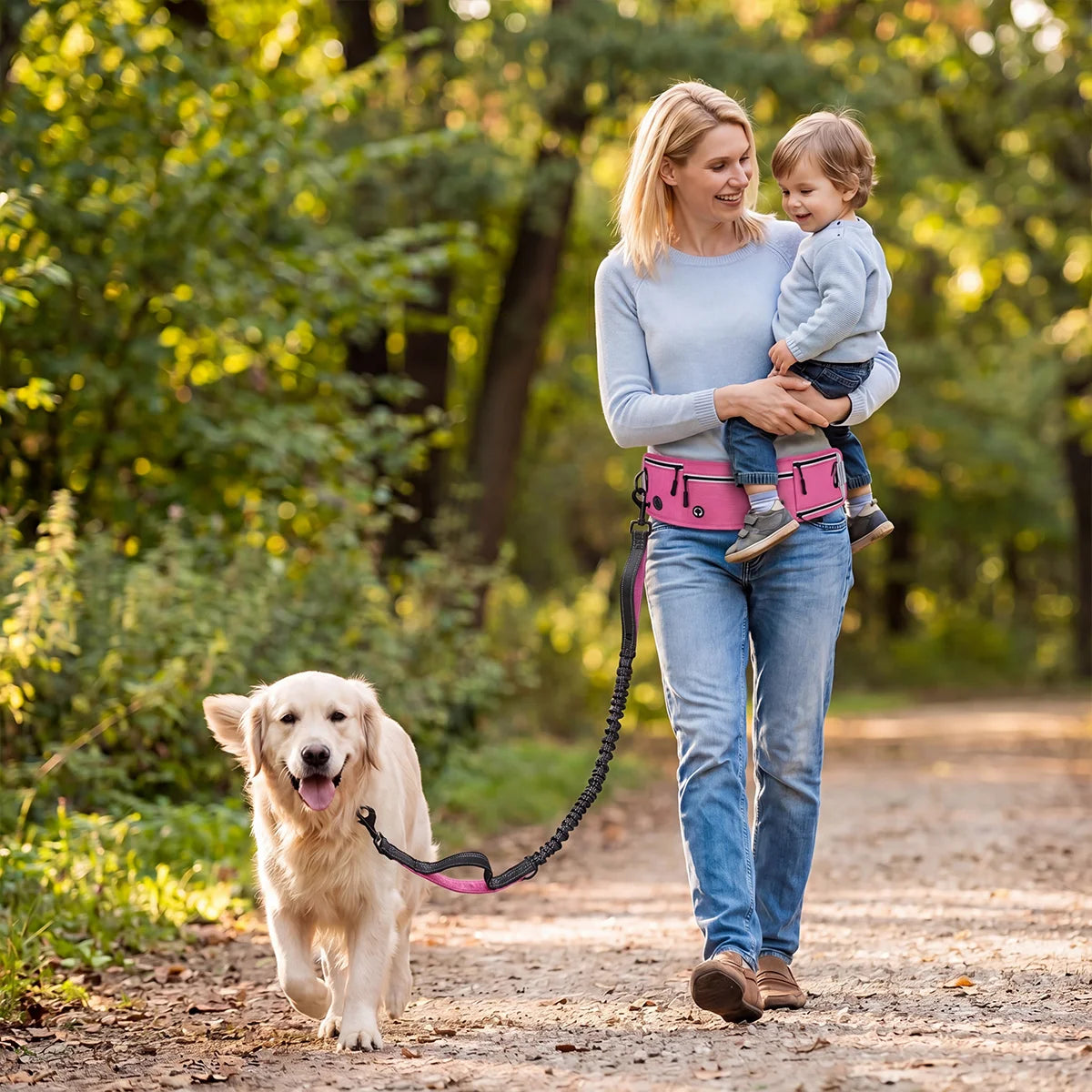
A hands-free leash can be highly convenient, but it is not automatically the right option for every dog or every situation. Understanding its strengths and limitations will help you decide when and how to use one.
The most obvious benefit is freedom of movement. When the leash is secured around your waist, your hands remain available for carrying a water bottle, holding treats, pushing a stroller, using trekking poles, or maintaining a more natural arm swing while running.
A waist dog leash can also distribute some of the dog’s pulling force across the owner’s core instead of concentrating it entirely on one hand, wrist, or shoulder. This can make longer walks feel more manageable, especially when the dog already understands basic leash manners.
For runners, a hands-free setup can help create a more consistent rhythm. You do not need to switch the leash from one hand to the other, and the dog can settle into a position beside or slightly ahead of you. Adjustable running leashes can also be shortened for sidewalks or extended for wider trails.
A bungee section provides another practical advantage. It can absorb smaller differences in stride, speed, and direction rather than transferring every movement through a completely static leash. The Ruffwear Roamer uses stretch webbing, while the Stunt Runner includes a flexible section designed to accommodate changes in stride and position.
Hands-free leashes are not limited to running. They can also be useful during hiking, daily walks, outdoor training, travel, and other situations where you need greater freedom to use your hands.
The biggest drawback is that sudden pulling can affect your entire body. If a large or reactive dog lunges unexpectedly, the force may pull at your waist and disrupt your balance. A bungee leash can soften some impact, but it cannot replace training or attentive handling.
To reduce this risk, begin with ordinary walks before using the leash for running. Practice changing direction, stopping, slowing down, and passing distractions. The dog should understand how to remain on one side without repeatedly crossing in front of you.
A waist leash may also offer less precise hand control than a short traditional leash. Choosing a model with a traffic handle helps address this limitation. The handle allows you to bring the dog closer when crossing a street or moving through a busy area.
Fit can also become uncomfortable when the belt is too loose, too narrow, or positioned incorrectly. The belt should remain secure without digging into your waist. Adjust it before attaching the dog, and test the setup during a short walk.
Finally, elastic leashes can create too much distance when fully extended. This is especially important on crowded sidewalks, near traffic, or around other dogs. Choose an adjustable leash and shorten it whenever the environment requires closer control.
The best hands free dog leash is not necessarily the one with the most features. It is the one that fits your body, matches your dog’s size and behavior, and works for your preferred activity.
A waist dog leash should fit comfortably and securely around your waist or hips, staying in place without slipping, twisting, or causing pressure points. Before attaching your dog, adjust the belt so it feels snug but still allows full freedom of movement and natural breathing.
When choosing a waist dog leash, always check the manufacturer’s size range to ensure a proper fit. Different brands offer varying adjustments, so selecting the right size is essential for both comfort and control during walks or runs.
Leash length is another important factor. It should match both your height and your dog’s natural running position. For example, taller owners paired with smaller dogs may benefit from a longer leash, while shorter owners with larger dogs may prefer a shorter connection for better control.
For everyday walking or jogging in urban areas, keep the leash shorter to prevent it from dragging or getting tangled near your feet. In more open environments like parks or trails, a slightly longer length can give your dog more freedom while still maintaining control.
Finally, pay attention to the leash attachment point. It should stay aligned with the side where your dog runs most comfortably. Some waist belts allow the leash to slide along the belt for flexibility, while others keep it fixed in one position. Always test the setup at a walking pace first to ensure stability and comfort before transitioning into running or jogging.
A jogging leash for dogs should be made from materials that can handle repeated movement, moisture, pulling, and outdoor exposure. Look for reinforced nylon or polyester webbing, strong stitching, reliable buckles, and metal attachment hardware.
The clips deserve particular attention. A weak or poorly secured clip can become a major safety concern when a dog changes direction quickly. Swiveling clips can help reduce twisting, while locking carabiners or reinforced attachment systems may add security for stronger dogs.
The bungee section should stretch smoothly without feeling overly soft. Too little elasticity provides minimal shock absorption, while too much can make it harder to control the dog’s distance. A well-designed elastic section should accommodate normal changes in stride without creating an uncontrolled slingshot effect.
Reflective stitching or webbing is valuable for early-morning and evening activity. It should not be treated as a replacement for proper lighting, but it can make the leash easier to see in low-light conditions. SparklyPets, for example, lists reflective stitching as one of the features of its hands-free leash.
Also consider cleaning requirements. Running leashes are likely to collect sweat, mud, dust, and moisture. A leash that can be hand-washed or gently machine-washed may be easier to maintain after regular outdoor use.
The Ruffwear Roamer is a versatile option for owners who want one leash for walking, running, hiking, and general outdoor use. It can be held in the hand, worn around the waist, or secured around a stationary object without first disconnecting it from the dog.
Its Wavelength stretch webbing is designed to stretch and absorb shock, making it useful when a dog changes pace during a run or trail outing. The leash also includes a traffic handle for quick restraint, a padded adjustable handle, an accessory loop, and a swiveling Talon Clip.
Ruffwear offers the Roamer in two adjustable length ranges: 5.5 to 7 feet and 7.3 to 11 feet. The longer option can provide additional room on open trails, while the shorter version may be easier to manage for everyday running and walking. The waist adjustment extends up to 48 inches.
This model is a strong choice for owners who want a flexible hands free dog leash with outdoor-focused materials and multiple handling options. However, runners who remain mostly on crowded sidewalks may prefer to keep it at its shortest setting, as extra leash length can become difficult to manage in tight spaces.
Best for: Hiking, outdoor running, active walks, and owners who want both hands-free and handheld use.

The Tuff Mutt Hands-Free Dog Leash is designed for medium and large dogs and uses a four-foot leash connected to an adjustable waist belt. Its straightforward structure makes it suitable for owners who want an accessible waist-worn system for walking, jogging, and general outdoor activity.
Tuff Mutt also offers a version with a bungee leash and twist-locking aluminum carabiners. According to the brand, the locking clips are intended to provide a more secure connection during walking, running, and hiking.
The bungee construction helps manage smaller changes in pace, which can make it a practical jogging leash for dogs that tend to move slightly ahead and then slow down. The shorter overall design can also provide more control than an extra-long running leash.
Because the product is primarily positioned for medium and large dogs, owners of very small dogs should consider whether the belt, clip, and leash weight are appropriate for their pet.
Best for: Everyday jogging, active walking, hiking, and medium-to-large dogs.

The Kurgo Quantum Leash 2.0 stands out because it can be converted into six different configurations. It can be worn around the waist, worn messenger-style across the body, used as a six-foot leash, shortened into a three-foot lead, configured for two dogs, or attached around an object as a temporary tether.
The leash adjusts from 48 to 72 inches using a ladder-style adjustment system. Two of its six configurations are hands-free, allowing owners to switch between running, walking, close control, and other everyday uses without carrying multiple leashes.
This is a useful choice for owners who value flexibility more than specialized running performance. It can function as a dog running leash, but it does not emphasize a bungee shock-absorbing section in the same way as dedicated running models such as the Ruffwear Roamer or Stunt Runner.
For dogs that pull suddenly, owners may prefer a separate shock-absorbing attachment or a leash designed specifically around elastic movement. For trained dogs and owners who frequently change activities, however, the Quantum offers considerable versatility.
Best for: Travel, daily walking, occasional running, crossbody use, and owners who want multiple configurations.

The SparklyPets Hands-Free Leash with Extra Security is built around a waist belt, flexible bungee section, dual handles, and stainless-steel clips. The brand positions it primarily for medium and large dogs.
One of its distinguishing features is the additional belt support system. Two stainless-steel clasps are designed to divide pulling force across both sides of the belt rather than placing all the tension on the plastic waist buckle.
The leash also includes an easy-grip control handle, weather-resistant nylon, reflective stitching, and a bungee section that can extend up to 68 inches. The waist belt adjusts from 28 to 47 inches. It can also switch from hands-free to handheld use.
These features make it a practical option for owners who want extra attention paid to the belt connection and close-control handling. The bungee and dual-handle design can be useful for active walking, jogging, and situations where the dog needs to be brought closer quickly.
As with other waist-attached leashes, owners of powerful dogs should introduce the system gradually and confirm that they can remain balanced when the dog changes direction.
Best for: Medium and large dogs, active walking, jogging, and owners who prioritize belt security and control handles.

The Stunt Puppy Stunt Runner is the most running-focused product in this selection. It is designed for roads, tracks, trails, and sidewalks, with a lightweight structure intended to keep the owner’s hands free.
The adjustable connector can be lengthened for single-file trail running or shortened for closer, side-by-side urban running. A movable D-ring on the waist belt helps position the dog without constantly pulling the belt around the runner’s body.
Its bungee section absorbs variations in stride, speed, and direction, while the static portion functions as a grab handle. The waist belt fits waists from 28 to 49 inches, and the flexible connector stretches from 42 to 66 inches.
Stunt Puppy lists tubular nylon webbing, lightweight carabiners, anodized aluminum hardware, and Duraflex buckles among the product’s materials.
Because the design focuses on low weight and running movement, it is a strong candidate for pet owners who jog several times per week. Owners who mainly need a leash for slow daily walks may find a more general-purpose convertible leash sufficient.
Best for: Regular runners, trail jogging, road running, and owners who prioritize lightweight equipment.

The Pet Dreamland Hands-Free Dog Leash for Two Large Dogs is designed for owners who want to walk two dogs from one waist belt. It combines a waist belt, leash extender, swivel splitter, individual lead sections, and multiple control handles.
The splitter helps the two leads move without creating the same level of twisting associated with two completely separate leashes. The owner can use the padded handle on the extender to control both dogs or use the individual handles to adjust one dog’s position.
The large-dog version is listed for two dogs weighing between 35 and 150 pounds each. Its waist belt adjusts from 27 to 48 inches. The lead sections and extender can also be adjusted by changing the knots or connection points.
This leash is better suited to controlled walking than serious running. Managing two dogs at jogging speed requires both dogs to maintain predictable positions and similar pacing. Owners should first practice with the system during short walks in a quiet environment.
Best for: Walking two medium or large dogs, reducing separate-leash tangles, and owners who need individual control handles.

If you're looking for a well-balanced option that combines comfort, safety, and performance, the Howoll Shock-Absorbing Reflective Hands-Free Running Dog Leash is worth considering. Designed specifically for active dog owners, this hands free dog leash features a durable waist belt and an elastic bungee section that helps reduce the impact of sudden pulling during running or jogging.
One of its standout features is the reflective stitching, which improves visibility in low-light conditions—an important factor for early morning or evening runs. The adjustable waist belt ensures a secure and comfortable fit, while the shock-absorbing design helps maintain a smoother running experience for both you and your dog.
This dog running leash is suitable for walking, jogging, and moderate running, making it a versatile choice for everyday use. It also includes a convenient handle for close control when needed, adding an extra layer of safety in busy environments.
Best for: Runners and active walkers who want a reliable, reflective, and shock-absorbing waist dog leash for daily exercise.

Even the best hands free dog leash can become uncomfortable or difficult to control when it is adjusted or used incorrectly.
A long leash may seem more comfortable because it gives the dog additional freedom, but too much length can create several problems. The leash may drop near your feet, wrap around your legs, catch on trail obstacles, or allow the dog to cross too far in front of you.
For sidewalks and jogging, adjust the leash so that it maintains a gentle curve without dragging. Your dog should have enough room to move naturally but not enough room to cut across your path.
Longer settings are more appropriate for open trails and low-traffic areas. Shorten the leash before approaching roads, people, bicycles, other dogs, or narrow sections of a trail.
Attaching a waist leash to a basic collar may place sudden tension directly around the dog’s neck, especially when the owner and dog are moving at different speeds.
A properly fitted harness is generally a more practical connection point for running, jogging, and dogs that occasionally pull. Check that the harness does not restrict shoulder movement and that the dog cannot slip backward out of it.
The harness should fit securely without rubbing. You should also inspect the leash clip and harness attachment point before every run.
A loose waist belt can slide, rotate, or move upward when the dog pulls. An overly tight belt can dig into the body and become uncomfortable during longer activities.
Adjust the belt before connecting the leash. Position it where it feels stable, then walk in several directions to see whether it moves. Once the dog is attached, test stopping, turning, and changing pace in a controlled area.
Do not assume that one setting will work for every outfit. The belt may need to be readjusted when worn over a thick jacket, running clothes, or hiking layers.
A hands free dog leash offers more freedom for walking, running, and jogging, but the best choice depends on your activity, dog size, and control needs.
Ruffwear Roamer is versatile, Tuff Mutt is simple and practical, Kurgo Quantum is highly adjustable, SparklyPets adds extra support, Stunt Puppy suits runners, and Pet Dreamland works for two dogs. Howoll is also a notable option, offering a balance of comfort, durability, and user-friendly design for everyday use.
Choose based on how you’ll use it, and start with short walks to ensure proper fit and control.
Please read our FAQs page to find out more.
It helps with mild pulling by distributing force and absorbing shock. However, strong pullers still need training, as they may cause imbalance.
About 4–6 feet is ideal. Shorter for crowded areas, longer for open trails. Adjust based on dog size and running style.
Yes, but use a lightweight version. Avoid heavy clips and keep the leash short.
Keep it short, train your dog to stay on one side, and use a swivel clip.