

- by JonesMila
Dog Tie Out for Yard and Camping: A Safe Outside Dog Leash Guide
- by JonesMila
Dogs enjoy being outdoors, but many spaces lack fencing and not all dogs stay close off-leash, so a dog tie out for yard or camping use provides controlled freedom by letting your dog move while preventing them from reaching unsafe areas.
A dog yard leash can attach to a stake, anchor, or overhead system to create a defined space for safe movement, but an outside dog leash should only be used with supervision and is not a substitute for exercise or interaction. This article introduces how to safely use a dog leash to give your dog controlled outdoor freedom while maintaining safety.
A dog yard leash is an outdoor restraint system designed to keep a dog within a designated area. Unlike a regular walking leash, which stays in the owner’s hand, a yard leash is connected to a secure anchor point. If you want to learn more about the components, you can read What Is a Dog Tie Out Cable? and What Is a Dog Tie Out Stake?.
Tie-out systems can vary in design, but they all serve the same purpose: to create a defined outdoor space where your dog can move safely while remaining connected to a secure anchor point.
A dog tie out for yard use is often chosen by owners who do not have a fully fenced backyard. It may allow a dog to lie in the sun, stay near the family, take a bathroom break, or enjoy supervised outdoor time without running away.
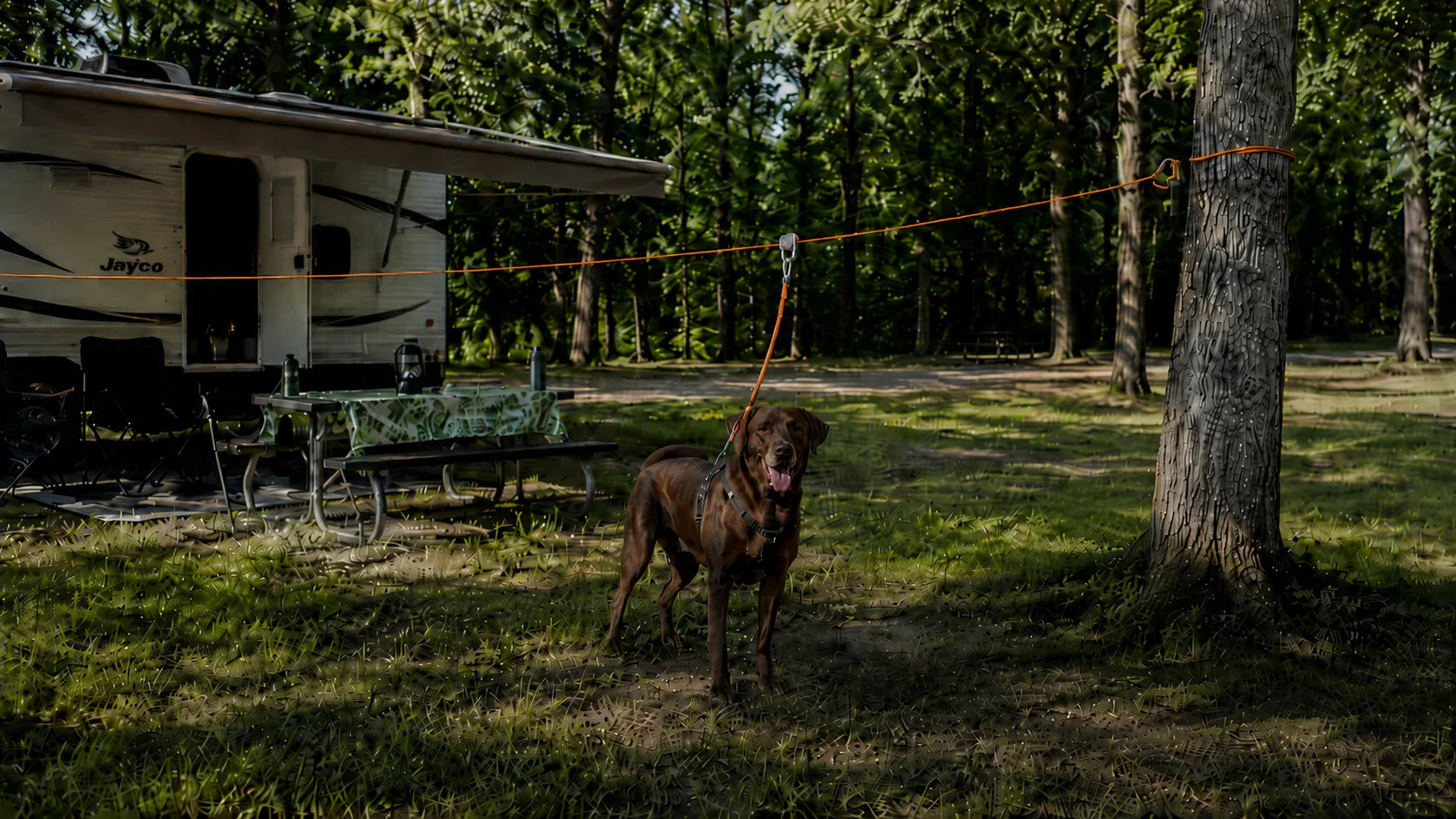
A dog tie out for camping refers to the same type of system, but it is typically used in outdoor travel settings and may be designed for easier portability. It can be installed temporarily at a campsite, RV site, picnic area, or other approved outdoor location.
The length of the cable determines how much space the dog can access. A longer cable provides more freedom, but it also increases the risk of tangling, reaching hazards, or building up speed before reaching the end of the line.
For that reason, the best outside dog leash is not always the longest one. The right length depends on the available space, the dog’s size, the surrounding obstacles, and how closely the owner can supervise.
A dog tie out is most useful when your dog needs temporary, controlled outdoor freedom. It is not suitable for every dog or every location, but it can be helpful in several common situations.
An unfenced backyard is one of the most common places to use a dog tie out for yard activities.
Without a fence, even a well-trained dog may leave the property after seeing a squirrel, another dog, a delivery driver, or a passing vehicle. A dog yard leash helps define a clear movement area while allowing the dog to spend time outdoors with the family.
A dog tie out is most useful when your dog needs temporary, controlled outdoor freedom. It is not suitable for every dog or every location, but it can be helpful in several common situations.

A dog tie out for camping can make outdoor trips easier when you need both hands for other tasks.
For example, you may need to set up a tent, unpack the vehicle, cook food, organize equipment, or start a campfire. Holding a standard leash during these activities can be difficult, while allowing the dog to roam freely may violate campsite rules or create safety risks.
A camping tie out allows the dog to stay close without requiring you to hold the leash every second. However, the campsite should be checked carefully before the cable is installed.

RV sites often provide more open space than traditional tent campsites, but they may also include vehicles, electrical connections, grills, tables, and neighboring campers.
A portable outside dog leash may help keep your dog near the RV while you prepare meals, arrange outdoor furniture, or relax outside. The cable should not cross a walking path or extend into another campsite.

Using a dog tie out for camping safely requires more than attaching a cable to the nearest tree or stake. The location, equipment, weather, and your dog’s behavior all matter.
Pet rules vary among national parks, state parks, private campgrounds, RV parks, and public recreation areas.
Some campsites require dogs to remain on a leash of a specific maximum length. Others may restrict where pets are allowed or prohibit attaching cables to trees.
Before your trip, check:
Following local rules helps protect wildlife, other campers, and your dog. It also prevents you from installing a dog tie out for camping in an area where it is not permitted.
The anchor must be strong enough for your dog’s size, weight, and pulling power.
A small dog may require less holding strength than a large, athletic dog that lunges toward wildlife. The anchor, cable, clips, swivels, and harness should all be rated for the dog using them. If you're unsure how to match the right equipment to your dog, you can refer to Dog Tie Out Size Guide: How to Choose the Right Tie Out for Your Dog for more detailed guidance.
For a ground stake, choose firm soil and insert the stake completely according to the manufacturer’s instructions. Loose sand, wet soil, and shallow ground may not provide enough resistance.
For an overhead system, use secure attachment points that can support tension without breaking or shifting. Do not attach the system to weak branches, unstable posts, campsite furniture, or equipment that could be pulled over.
Test the full setup before connecting your dog. Pull firmly on the cable and inspect every attachment point.
A tie-out cable can knock over objects, wrap around tent stakes, or create a tripping hazard.
Place the outside dog leash far enough from:
Consider the entire radius of the cable, not just the location of the anchor. Your dog should not be able to reach any dangerous object, even when the leash is fully extended.
The resting area should remain open and easy to see. A clear setup makes it easier to notice tangles or equipment problems before they become dangerous.
Never leave a dog alone on a tie out at a campsite.
A dog may become tangled, frightened by wildlife, approached by another dog, or exposed to sudden weather changes. Even a secure system cannot protect against every outdoor risk.
Stay close enough to respond immediately. Check the cable regularly and reposition it if it begins to wrap around an object or the dog’s legs.
A dog tie out for camping should be used while you are nearby and actively aware of your dog.
Visibility becomes especially important after sunset.
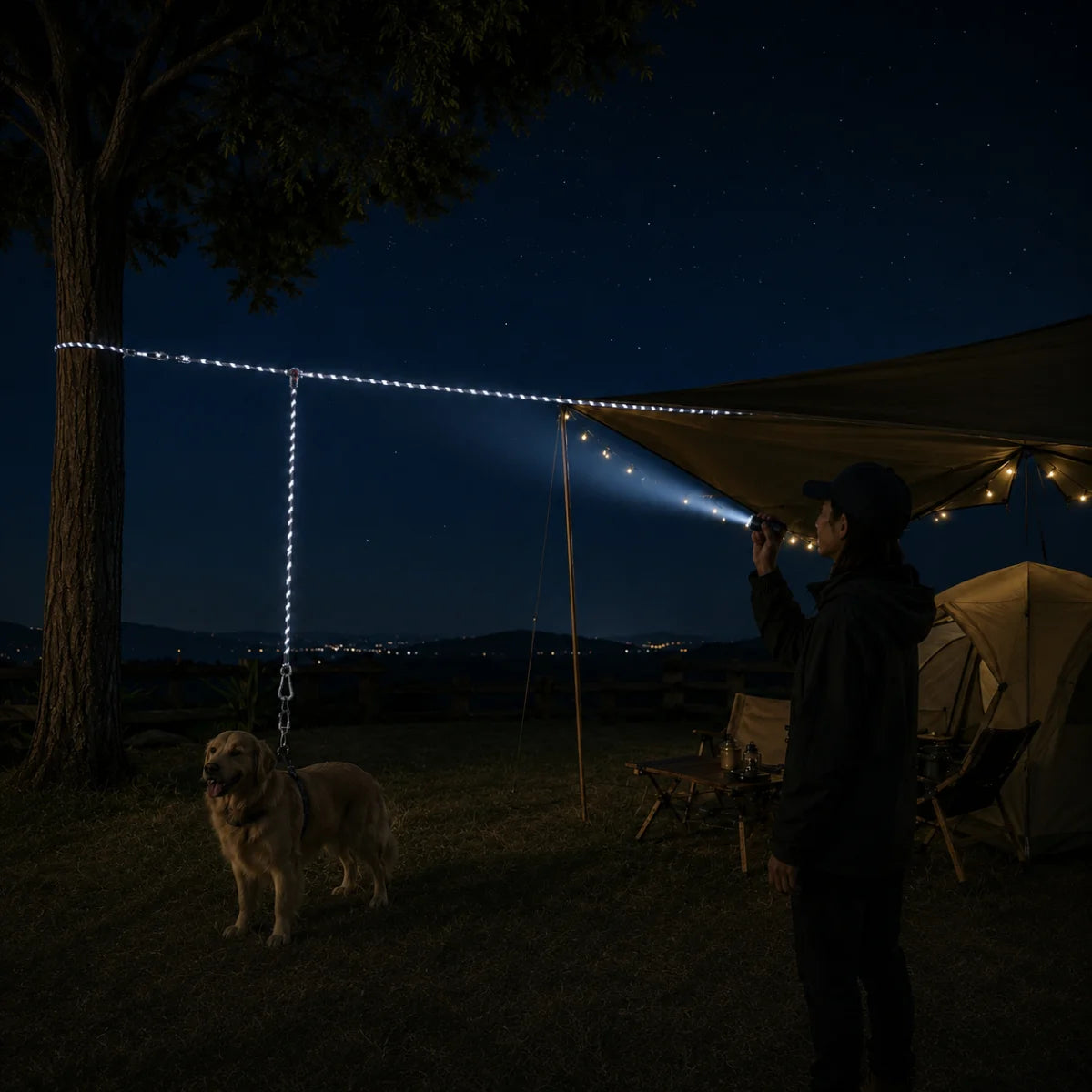
A reflective cable, reflective harness, LED safety light, or illuminated collar can make your dog easier to see around the campsite. Reflective equipment also helps other campers notice the cable and avoid tripping over it.
Before dark, inspect the setup with a flashlight. Make sure the dog yard leash or tie-out cable is visible from common walking directions.
Nighttime supervision remains necessary even with reflective gear. Wildlife may become more active after dark, and your dog may react differently when visibility is limited.
Combining reflective equipment with close monitoring can help keep your dog safe during evening outdoor time.
A dog tie out can only work safely when it is used correctly. Avoiding these common mistakes can reduce the risk of injury, escape, and equipment failure.
Connecting a tie-out cable directly to a collar can place sudden pressure on the dog’s neck and throat.
If the dog runs toward the end of the line, the force may cause choking, coughing, neck strain, or injury. A properly fitted harness distributes pressure across a wider area of the chest and body.
Choose a strong, comfortable harness that fits securely without restricting movement. Check that your dog cannot back out of it.
Using a harness is an important step when setting up a dog tie out for yard or camping use.
A longer cable gives the dog more space, but it can also create more risks.
For most small to medium dogs (under 20 kg / 44 lbs), a cable length of 3–6 meters (10–20 feet) is usually sufficient. For larger dogs (over 20 kg / 44 lbs), a length of 6–9 meters (20–30 feet) may be appropriate, depending on the available space.
The dog may build up more speed before reaching the end, access unsafe areas, wrap around objects, or cross paths where people are walking.
Choose the shortest length that provides reasonable movement within the available space. A compact backyard may work best with a 3–4 meter (10–13 feet) dog yard leash, while an open campsite may safely support a 6–9 meter (20–30 feet) line.
Always test the full radius before connecting your dog.
Trees, furniture, firewood, tables, rocks, grills, and tent equipment can cause the cable to become tangled.
Once tangled, the dog’s movement area may become smaller, or the cable may wrap around the legs or body. A frightened dog may pull harder and make the situation worse.
Clear the area before using an outside dog leash. Continue checking it throughout outdoor time because people may move equipment into the dog’s space later.
Two dogs should not be attached to the same single cable unless the system is specifically designed and tested for multiple dogs.
Their lines may twist together, wrap around their legs, or cause the dogs to collide. Excitement, food, toys, or nearby animals may also trigger conflict when both dogs are restricted in the same area.
Use separate systems with enough distance between them, or keep one dog on a handheld leash. Each dog should have its own supervised space.
A tie out is designed for temporary outdoor use. It should not replace walks, exercise, training, play, or time with the family.
Dogs left outside for extended periods may become bored, frustrated, anxious, overheated, cold, or reactive. They may also begin chewing the cable, barking excessively, digging, or trying to escape.
Whether you use a dog tie out for camping or a dog tie out for yard activities, keep each session appropriate for the weather, the dog’s comfort, and the activity.
Bring your dog inside or return them to a secure resting space when outdoor time is finished.
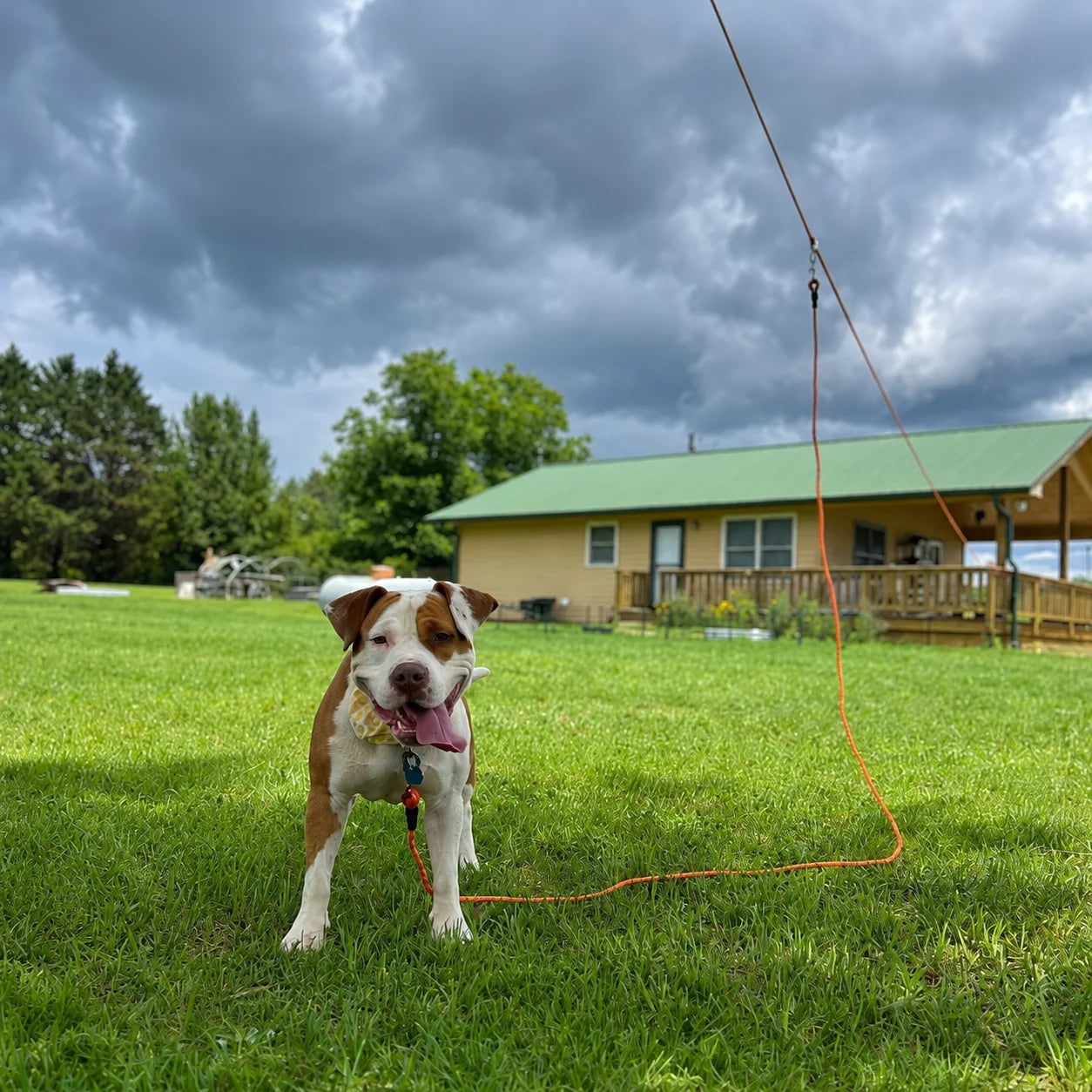
In conclusion, a dog tie out is an invaluable tool for ensuring your furry friend enjoys the great outdoors safely. Whether in your yard or while camping, using the right tie out can enhance your dog's experience while giving you peace of mind. Remember to follow best practices, such as choosing the appropriate length and keeping the area clear of obstacles, to prevent accidents. By staying informed about common mistakes and prioritizing safety, both you and your dog can enjoy countless adventures together. If you’re ready to explore the best options for your pet, contact us for a free consultation today!
Howoll is a brand dedicated to creating practical, durable, and safety-focused solutions for pet owners who enjoy spending time outdoors with their dogs. Built around real-life scenarios such as backyard relaxation, camping trips, and RV travel, Howoll emphasizes thoughtful design that balances freedom and control, helping owners feel confident while their dogs explore their surroundings.
The brand stands out for its commitment to reliability and long-term performance. By prioritizing strong materials, careful construction, and attention to detail, Howoll ensures that its offerings can withstand daily use as well as more demanding outdoor conditions. This focus on durability reflects the brand’s goal of supporting active lifestyles without compromising safety.
Please read our FAQs page to find out more.
Only for short, supervised periods. There is no fixed time limit—duration depends on the dog’s age, health, temperament, weather, and environment. Monitor closely and bring the dog inside if signs of stress appear. A tie out is not a substitute for exercise or interaction.
Yes, but only briefly and under close supervision. Use a properly fitted harness, not a collar. Start in a safe, open area with a short cable. Avoid letting the puppy run to the end of the line. Puppies that chew, panic, or lack leash training should not use a tie out yet.
Set it up in an open space free of obstacles. Use swivel clips or rotating attachments, and keep the cable length appropriate. An overhead system helps reduce tangling. Check frequently and fix any tangles immediately.
Overhead systems are better for larger, open areas and reduce tangling. Stakes are easier to install and more portable, suitable for short-term use. Choose based on space, ground conditions, and your dog’s size and strength. Both require proper setup and supervision.