


Best Puppy Harnesses: How to Choose the Right First Harness
- by HuangMila
The best puppy harness is light, comfortable, secure, and adjustable enough to keep fitting as your puppy grows. It should sit across the chest rather than the throat, allow the shoulders and front legs to move freely, and remain in place when your puppy turns or backs up.
For most puppies, a soft adjustable harness is the best place to start. A back clip keeps early walks simple, while a front-and-back dual-clip design offers more flexibility as leash training progresses. The right choice depends less on breed labels and more on your puppy’s measurements, body shape, behavior, and rate of growth.
If you are still comparing shapes and attachment points, start with our overview of the main types of dog harnesses. It explains how back-clip, front-clip, vest, step-in, and other designs work before you narrow the choice for your puppy.
We used five criteria: current fit information, adjustability for growth, contact materials, control options, and ease of use. Each pick needed a clear reason to exist in the list. The reflective model is the balanced everyday choice, the cotton-linen set favors small puppies and softness, and the dual-clip handle model offers the widest published fit range for growing medium and large puppies.
Fit remains individual. A product can have the right features and still be the wrong shape for a particular puppy. Measure before ordering, compare the result with the live product page, and recheck the fit during growth spurts.
Use a soft measuring tape to measure around the widest part of your puppy’s chest, usually just behind the front legs. If the product asks for a neck measurement, measure around the base of the neck where it meets the shoulders—not high on the throat.
Compare both measurements with the product-specific chart. Weight can be a useful cross-check, but chest and neck measurements are more reliable because puppies of the same weight can have very different body shapes.
Body proportions also vary between breeds. Our dog harness by breed guide explains why chest depth, neck width, back length, and leg position can change the fit even when two puppies weigh the same.
If your puppy is between sizes, check the adjustment range and the manufacturer’s instructions rather than automatically sizing up. A harness that is too large now is not made safe by the fact that the puppy may eventually grow into it.
For a visual walkthrough, see our guide on how to measure a dog for a harness.

An adjustable puppy harness is especially helpful during growth spurts. Adjustment at both the neck and chest allows you to center the harness and keep the straps away from sensitive areas.
Recheck the fit every week for a young, fast-growing puppy and after grooming, weight changes, or switching between a thick coat and a short summer trim. The American Kennel Club notes that harnesses can be a good option for puppies when owners adjust the size or replace the harness as the puppy grows.
A puppy harness should place leash pressure across the chest and torso rather than directly against the throat. The chest panel or front strap should sit low enough to avoid pressing into the neck but high enough that it does not fall onto the soft belly.
Look for flat straps, smooth edges, breathable padding, and enough space behind the front legs to prevent armpit rubbing. Softness alone does not guarantee comfort; a soft puppy harness can still chafe if it is twisted, loose, or positioned incorrectly.
Fabric affects weight, airflow, drying time, and durability. See our dog harness material guide for a closer comparison of mesh, nylon, Oxford fabric, neoprene, polyester, and leather.
Have your puppy walk, sit, turn, and take several steps after the first adjustment. The harness should not shorten the puppy’s stride or cut across the moving part of the shoulder.
A well-fitting harness should stay centered while allowing the front legs to reach forward naturally. The American Kennel Club advises checking that a harness does not restrict leg movement, while VCA Animal Hospitals recommends a body harness that is adjustable and does not rub behind the elbows.
Back-clip puppy harness: Easy to use for calm walking and early harness training. It keeps the leash away from the front legs but may give a strong puppy more leverage to pull.
Front-clip puppy harness: Can make it easier to redirect a puppy that pulls forward. It must sit correctly and should be paired with reward-based loose-leash training.
Dual-clip harness: Offers both options and may remain useful as the puppy’s walking skills develop. Some owners use a double-ended leash for balanced contact at the front and back.
Step-in puppy harness: Useful for puppies that dislike having equipment passed over the head. It may be less convenient for puppies that resist paw handling.

A puppy harness should be snug enough that the puppy cannot reverse out of it, but not so tight that it pinches, rubs, or restricts breathing and movement.
Run this five-point check before every walk:
Then perform a careful escape check indoors. Hold the leash steady and let your puppy take a step backward. If the neck opening begins to pass over the head or a leg can slip through a strap, stop and readjust the harness.
Do not leave a puppy wearing a harness unattended. Buckles and straps can catch on crates, furniture, branches, or other objects.
The best training harness for a puppy is one the puppy can learn to wear without fear. Start in a quiet room and keep the first sessions short.
Never chase the puppy with the harness or force the head through an opening. If your puppy repeatedly backs away, growls, freezes, or tries to bite when the harness appears, slow the process down. A trainer or veterinary professional can help if handling sensitivity persists.
For wearing instructions, see how to put on a dog harness correctly.
A no-pull puppy harness can improve control, but it does not teach loose-leash walking by itself. Front attachment changes the direction of force when a puppy pulls, which can make it easier to guide the puppy back toward you. Training still needs to reward the behavior you want: a loose leash, attention, and walking near you.
Avoid jerking the leash. VCA Animal Hospitals advises introducing walking equipment gradually and using it without causing pain or discomfort. Pair the harness with short sessions, treats, frequent direction changes, and realistic expectations for a young puppy.
For a detailed explanation of front attachment points and their limitations, read what a no-pull dog harness is and how it works.
Avoid these six errors:
These three HOWOLL harnesses cover distinct puppy needs: everyday visibility, a softer fit for small puppies, and broader adjustment for growing medium or large puppies.
The Howoll No-Pull Reflective Dog Harness is the most versatile choice for everyday puppy walks. It combines soft inner padding with adjustable straps and reflective webbing, helping a puppy stay comfortable and visible during early-morning or evening outings.
Front and back leash attachment points make the harness useful beyond the first few walks. The back clip is straightforward for relaxed walking, while the front clip can provide extra directional control during training. The set also includes a 1.5-meter reflective leash, so a new puppy owner can build a complete walking setup without choosing every part separately.
The published chest ranges are S: 13.4–18.1 inches, M: 18.1–22.0 inches, L: 22.0–26.0 inches, and XL: 24.4–28.34 inches. Because L and XL overlap, select according to your puppy’s current chest measurement and the amount of adjustment you need rather than assuming the larger size is safer.
Best for: small to medium puppies that need a padded, adjustable everyday harness.
Consider another option if: your puppy’s chest is smaller than the listed minimum or your puppy needs a harness with a wider growth range.
Buying conclusion: Pick this model if you want the most balanced everyday package—padding, visibility, two leash attachment choices, and a matching reflective leash.

For a small puppy, weight and texture matter. The Howoll No-Choke Cotton Linen Dog Harness & Leash Set uses a soft cotton-linen fabric and a vest-style shape that spreads contact over a wider area than a narrow neck strap.
The product is offered in XS, S, M, and L. Its listing asks buyers to check back length, chest girth, and neck circumference and recommends using back length first, then cross-checking the chest and neck. Exact numeric ranges are not shown in the accessible product text, so verify the live size chart or contact HOWOLL before ordering instead of relying on the XS–L labels alone.
The included leash and collar make this a convenient first walking set. A secure buckle supports everyday use, while the softer construction may suit puppies that initially dislike stiff or bulky gear.
Best for: small puppies, first walks, and owners looking for a softer harness-and-leash set.
Consider another option if: you need front and back leash attachment points or a wide adjustment range for a fast-growing puppy.
Buying conclusion: Pick this set for a small puppy when softness, low bulk, and an all-in-one starter kit matter most.
For more lightweight options and small-breed fitting advice, compare our recommended harnesses for small dogs.
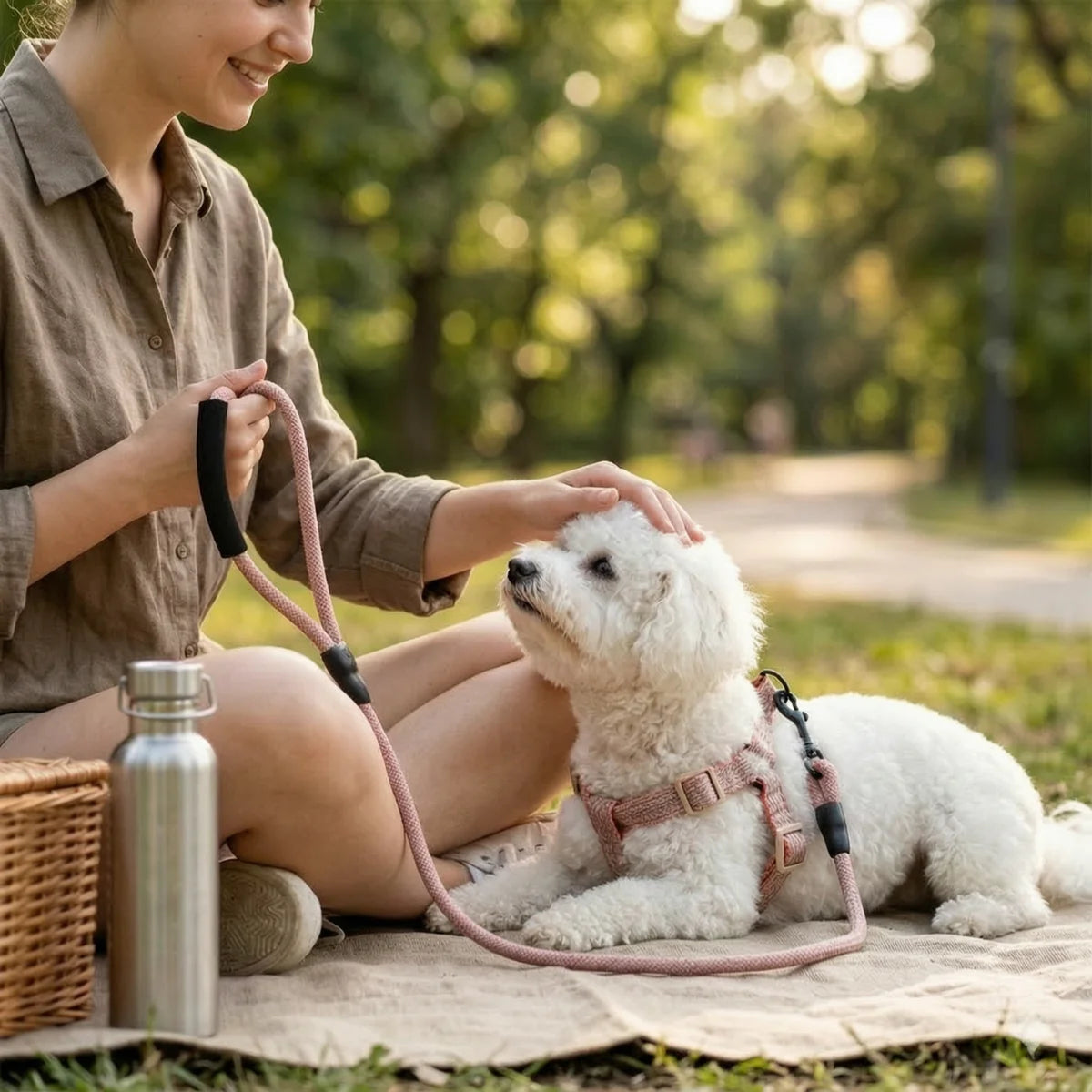
Large-breed puppies can grow quickly, so an adjustable puppy harness needs enough range at both the neck and chest. The Howoll No-Pull Dual-Clip Handle Dog Harness has four adjustment points, sizes from S to XL, padded mesh, front and back leash clips, reflective strips, two quick-release buckles, and a top handle.
The published ranges are S: neck 13–19 inches and chest 13–24 inches; M: neck 16–22 inches and chest 15–28 inches; L: neck 18–26 inches and chest 17–33.6 inches; and XL: neck 23–35 inches and chest 21–38 inches. These broad, overlapping ranges give owners more room to fine-tune the fit, but the harness still needs to fit securely on the day it is worn.
The back handle can help you guide a puppy at a curb, near traffic, or through a crowded entrance. It should be used for brief guidance rather than routinely lifting a puppy by the harness. The front clip can also support loose-leash training, but equipment is not a substitute for rewarding calm walking behavior.
Best for: growing medium or large puppies that need more adjustment and control options.
Consider another option if: your puppy is very small or finds an overhead harness difficult to wear.
Buying conclusion: Pick this model for a fast-growing medium or large puppy when adjustability, dual attachment points, and close-range control are the priorities.

The best puppy harness is the one that fits securely now, moves comfortably with your puppy, and suits the way you plan to walk and train together. Start with accurate measurements, prioritize adjustment and freedom of movement, and check the fit often as your puppy grows.
For an everyday padded option with reflective details and two leash attachment points, consider the Howoll No-Pull Reflective Dog Harness. Small puppies may prefer the softer No-Choke Cotton Linen Dog Harness & Leash Set, while fast-growing medium and large puppies may benefit from the wider adjustment range of the No-Pull Dual-Clip Handle Dog Harness.
Whichever design you choose, introduce it gradually, reward calm behavior, and make fit checks part of your regular walking routine.
Please read our FAQs page to find out more.
A harness distributes leash pressure across the body and can reduce direct pressure on the neck when a puppy pulls. A collar remains useful for identification tags. The safest walking setup depends on fit, behavior, body shape, and veterinary guidance for any medical concern.
A puppy can be introduced to a properly fitted harness during early home training. Ask your veterinarian when it is safe for your puppy to walk in public areas, since vaccination timing and local disease risks vary.
No. XS is not a universal measurement. One brand’s XS can differ substantially from another’s. Use actual neck and chest measurements and the exact size chart for the harness you are considering.
It is safer to remove the harness before sleep, crating, or unsupervised rest because straps and buckles can snag. If a veterinarian has recommended continuous use for a specific reason, follow that individual advice.